Cross Lapper for Nonwoven Lines: Weight Profiling and Supply
The machine that turns a light carded web into a full-weight batt, laid evenly across the whole width.
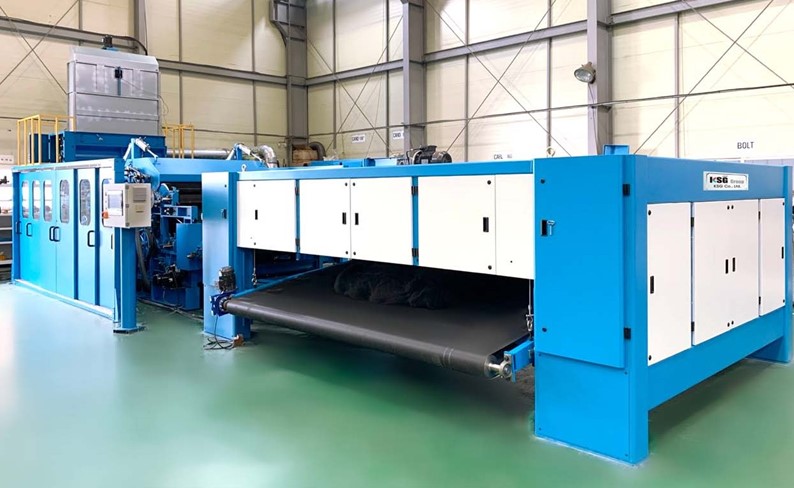
A card produces a web that is far too light and too narrow to bond on its own. The cross lapper for nonwoven production is the machine that fixes both problems at once: it takes the thin veil off the card and folds it back and forth across a wider apron, building the batt up to the target weight and width before it goes to the needle loom or dryer. KSG has been building cross lappers and the lines around them for more than 30 years, with installations in over 40 countries.
What a cross lapper actually does
The principle is simple to describe and hard to do well. A carriage carries the incoming card web across the machine width and lays it down in overlapping layers on a slowly moving output apron, much like folding a ribbon back and forth. The number of layers, set by the ratio between the incoming web speed and the apron speed, decides the finished batt weight. Widen the layering stroke and you get a wider fabric; add layers and you get a heavier one.
Because the batt is built from many crossed layers rather than one thick web, the cross lapper also controls fibre orientation. Laying the web crosswise adds cross-machine-direction strength that a straight card web lacks, which is one reason needle-punched and thermally bonded fabrics are so much more balanced than a single-pass web would be.
This layering is also where basis weight is set. Between the card, the cross lapper and any draw before the loom, the operator can dial a fabric from a light interlining up to a heavy geotextile batt on the same line. That flexibility is a large part of why dry-laid lines are so versatile.
Why weight distribution across the width matters
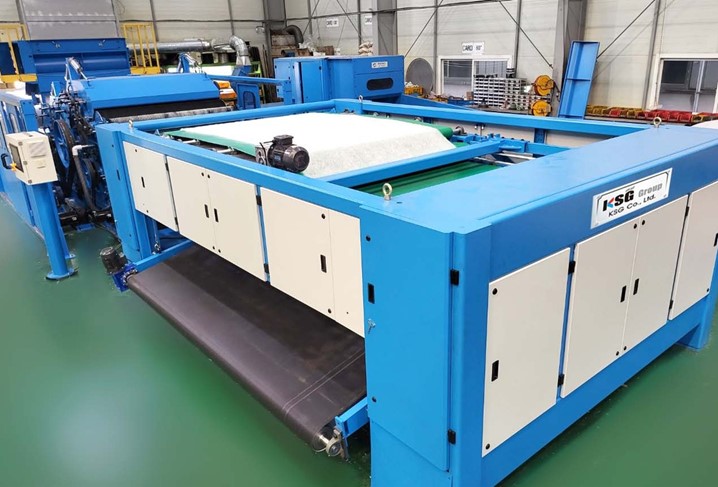
The failure mode buyers worry about most is a batt that is heavier at the edges than in the middle, or the other way round. As the lapper carriage reverses at each edge it naturally dwells for an instant, which tends to pile extra fibre at the selvedges unless the machine compensates for it. Left uncorrected, that shows up as a cross-width weight profile that is out of tolerance, which means either off-spec fabric or wide trim losses at the edges.
A good cross lapper machine manages that profile deliberately. Profiling control adjusts the lay-down so the finished batt holds an even weight from selvedge to selvedge, which keeps the fabric in spec and cuts the trim the side cutter has to remove downstream. On heavy fabrics a percent or two of trim saved across a year is real money, so this is not a cosmetic concern.
It is worth being honest that the cross lapper can only profile what the card gives it. If the incoming web is streaky the lapper will faithfully layer those streaks, which is why we always specify the card and the lapper together rather than in isolation.
High-speed lapping with compensation
As card outputs have risen, the cross lapper has had to keep pace, and moving a carriage full of fragile web quickly without stretching or distorting it is genuinely difficult. Our HS cross lapper is built for that: it runs the carriage at high infeed speeds while web-tension and layering compensation keep the web from being drawn thin at the turns. The result is a heavy batt laid fast without sacrificing the even weight profile.
The high-speed motion has to be smooth as well as quick. Sudden acceleration at the carriage reversals is what tears light webs and drives edge build-up, so the drive and motion control are the parts that earn their keep on a fast lapper. This is machinery where control quality, not just top speed, decides whether the fabric is any good.
We size the lapper to the card feeding it. A high-speed cross lapper paired with an undersized card is wasted capacity, and a slow lapper behind a fast card is a bottleneck, so matching the two is part of the line design rather than an afterthought.
Pairing the lapper with the rest of the line
The cross lapper never works alone. Upstream it is fed by our carding machine and opening equipment; downstream the batt goes to a needle punching machine for mechanical bonding, or to a heating roll and bonding dryer line for thermal bonding, before a side, cross or rotary cutter finishes it to width and length. Because KSG builds all of these machines, we time the lapper to the card and the loom so the three run as one system rather than three separate purchases.
That is the reason we supply the cross lapper as part of a line rather than as a standalone unit. The same engineering team that draws the layout installs and commissions it on the customer's floor, and with plants running in more than 40 countries we know how to make the lapper hold its weight profile once it is on a real production line, not just in a factory test. One partner, from line design through to saleable fabric.
If you are specifying a cross lapper for a new nonwoven line or upgrading an existing one, tell us your card output, target fabric weight and width. KSG will match the HS cross lapper to your card and needle punching or bonding section, build the line and install it in your plant through to an even, in-spec batt.
Related equipment
Related industry guides
Ready to integrate the Cross Lapping?
Contact our sales engineers to discuss integration, custom configurations, and pricing for your facility.