Carding Machine for Nonwoven Web Formation and Complete Lines
The card sets the ceiling on fabric quality, so we build the carding section and the line around it as one system.
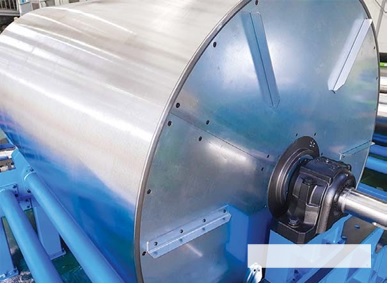
Ask any plant engineer where a dry-laid nonwoven line is won or lost and most will point at the card. The carding machine for nonwoven production is where loose, opened fibre is combed into a thin, even web, and every stage after it, cross lapping, bonding, finishing, inherits whatever the card produces. KSG has been building carding machines and the lines around them for more than 30 years, with installations in over 40 countries, and we treat the card as the machine that decides the rest of the job.
The heart of dry-laid web formation
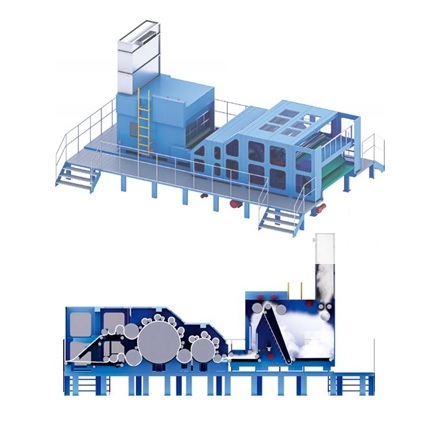
A card works by carrying fibre over a large, wire-clothed cylinder past a series of worker and stripper rolls that comb the tangled mass into parallel, individualised fibres. A doffer lifts that thin veil off the cylinder and hands it on as a continuous web. Done well, the web is uniform in weight and cloudless when you hold it to the light; done badly, it carries nep, holes and streaks that no downstream machine can fix.
That is why we describe the card as the heart of a dry-laid nonwoven line and not just one machine among several. The cross lapper can build weight and the needle loom or dryer can bond the batt, but neither can add fibre that was never laid down evenly in the first place. A clean, consistent web off the card is the single biggest factor in the quality of the finished fabric.
Because the card matters so much, we do not sell it as an isolated box. We specify the carding machine as part of the whole line so its output matches what the opening room feeds it and what the lapper and bonding sections expect from it.
Feeding accuracy is half the battle
A card can only comb what it is fed, and uneven feeding is the most common cause of weight variation we are called in to cure. That is why the feed section gets as much attention as the card itself. Our hopper feeder meters opened fibre into the card at a controlled, consistent rate, and on lines where basis weight tolerance is tight we use a scale-box or weighing hopper feeder that trims the feed continuously to hold the target.
Ahead of the hopper feeder sits the opening line, super blender and fine opener, that loosens and blends the fibre so it arrives at the card open and homogeneous rather than clumped. A card fed with clumps will comb clumps. Getting the feed chain right is unglamorous work, but it is where a surprising amount of finished-fabric uniformity is actually decided.
For blends the feed section also has to mix consistently, so batch-to-batch colour and composition stay steady. We size the feeding equipment around the fibre and the weight range the customer actually runs, because a feed built for coarse recycled stock behaves nothing like one built for fine hygiene fibre.
Wire and speed set up for the fibre
There is no single card that is ideal for everything. Card clothing, the metallic wire on the cylinder, workers and doffer, is chosen for the fibre denier and length being run. Fine, short hygiene fibres want a different wire population and tooth geometry than coarse geotextile or recycled stock, and running the wrong clothing gives you either poor opening or fibre damage. We specify the wire for the customer's fibre mix rather than shipping a generic configuration.
Cylinder speed, worker-roll settings and doffer speed then trade off against each other to balance throughput against web quality. Push the card too hard and uniformity suffers; run it gently and you leave output on the table. Finding the right operating point is part of what we prove out at commissioning, not something we leave to the customer to discover alone.
Peripheral equipment matters too. A dust filter keeps the card room clean and protects the wire, and options such as an air brake or cross-direction hopper feeder help hold the web steady across the full working width. These are the details that separate a card that looks fine on a spec sheet from one that runs cleanly for years.
The KSG carding lineup, one partner from design to start-up
We build a range of carding machines to suit different fibres and outputs, with feed options spanning nose-bar and four-roller types for low-denier work through to standard and vertical-hopper feeding for heavier stock. Whatever the configuration, the card is engineered to sit in a KSG line alongside our own opening equipment, HS cross lapper and bonding sections, so the whole nonwoven carding line is timed to work together.
Because we manufacture the machines ourselves, the team that draws the layout is the team that installs and commissions it, and spare parts such as card clothing come from the people who built the line. With installations in more than 40 countries, we know the realities of standing a card room up on a new site. That continuity, one partner from first drawing to saleable web, is the point of buying the line from us as a single package.
If you need a carding machine for nonwoven fabric or a complete carded line, tell us your fibre type, target web weight and output. KSG will specify the card, feeding and opening equipment around your product, build it, and install and commission it in your plant through to a clean, uniform web.
Related equipment
Related industry guides
Ready to integrate the Carding?
Contact our sales engineers to discuss integration, custom configurations, and pricing for your facility.