
Hopper Feeder
Automated fiber storage, blending and metered feeding for the carding line.
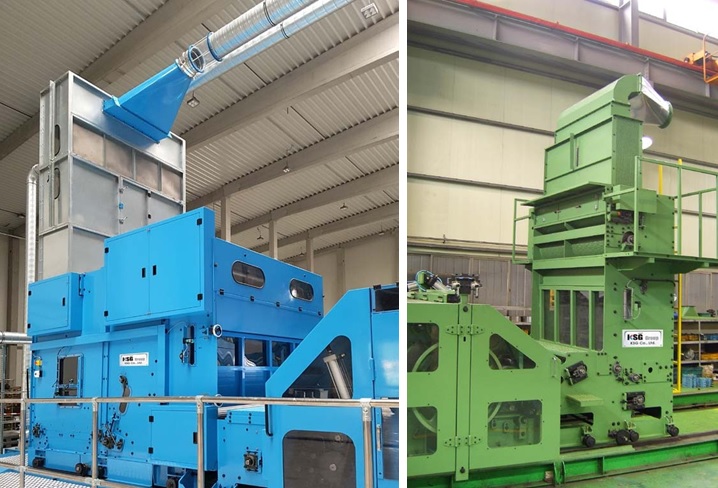
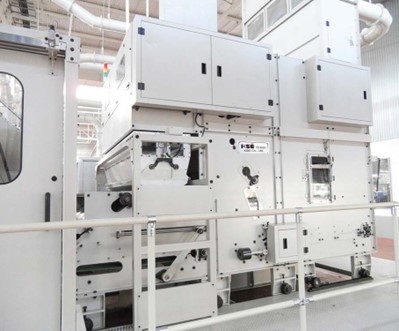
The hopper feeder sits at the head of the carding line. Its job is simple to state and hard to do well: keep a steady, uniform supply of fiber moving to the next machine while doing most of the leveling and blending on its own. Doing that automatically cuts the manual handling that otherwise slows a high-volume line down.
Opened fiber is loaded into the upper storage box, then carried downward by a spike lattice or conveyor. A feed roller lightly compresses the stock while cylinder pins or a spiked apron open it further, so what leaves the machine is a loose, even layer rather than clumps. A vibrating chute or room evens out the density on the way to the carding machine.
For dosing, you can specify an automated measuring type that uses load cells to track transferred weight and a servo motor to top up to target, or a scale box type that accumulates set batches before releasing them onto the conveyor. Both keep batch-to-batch weight consistent; the vibrating chute lets you fine-tune pad density and thickness by wall distance or vibration amplitude.
The feeder handles virgin, blended and recycled stock, and works with both natural and synthetic fibers. It is the same machine the industry calls a vibrating, weighing, automatic or pre-feeder depending on how it is configured.
How this stage contributes to the line
An even web depends on the feeder, card and lapper working together. KSG's catalogue describes different feed arrangements and wire selection for fiber thickness and length. The cross lapper then manages web placement and weight distribution, while the needle loom provides the required mechanical consolidation.
Explore KSG's integrated engineering approach Existing Line UpgradesInformation that defines the right configuration
Equipment selection and pricing depend on the product, process, output, site, and supply scope. Prepare these points before requesting a technical proposal.
Product and application
End use, sample product, quality targets, roll or pack format, and required product range.
Raw materials
Fiber or polymer, blend, denier, staple length, additives, and material condition.
Output and dimensions
Target throughput, GSM range, finished and process width, tolerances, and changeovers.
Facility and utilities
Layout, clear height, access, power, heat, air, water, ventilation, and local standards.
Project and support scope
Automation, controls, installation, commissioning, training, acceptance, and spare parts.
Technical Specifications
Hopper Feeder model specifications
| Specifications | HF80 | HF100 | HF120 |
|---|---|---|---|
| Working Wide | 1900mm | 2400mm | 3000mm |
| Capacity | 400kg/Hr | 550kg | 650kg/Hr |
| Horse Power | 8.2Kw | 8.2Kw | 9.95Kw |
Gallery
Key Features
Uniform mixing and feeding
Mechanical opening, vibration and feedback-controlled dosing combine to deliver fiber as one continuous, homogeneous layer.
Automatic metal removal (option)
Magnetic bars or delivery plates can be fitted to pull ferrous debris out of the stream, protecting downstream machines.
Easy cleaning and maintenance
Hinge-type belts and removable aprons open the machine up, and collecting boxes make it quick to clear residual fiber at material changes.
Chemical application (option)
Sprinkler bars can apply softening or antistatic agents to the fiber during feeding.
Straightforward controls
The operation panel gives operators direct control and monitoring of the main functions without a steep learning curve.
Applications
Interested in the Hopper Feeder?
Contact our sales engineers to discuss integration, custom configurations, and pricing for your facility.