
Airlaid Nonwoven Machine Guide: Air Forming, Absorbent Cores and Carded Alternatives
How air forming builds a web from short fibres and pulp, where it suits absorbent products, and where a carded dry-laid line does the same job.
If you are researching an airlaid nonwoven machine, you are probably looking at absorbent products: tabletop, wipes, feminine-care cores, food pads. This guide explains what air laid nonwoven really is, why the fibre length drives the whole process, and how it compares with the carded dry-laid webs KSG builds lines for. We will be honest about the boundary. Air forming of short fibres and fluff pulp is a distinct process, and KSG does not build the air-forming head itself; we build the carded staple-fibre lines that serve many of the same products by a different route.
What air forming actually is
Airlaid is a dry-laid process, but it forms the web with air rather than with carding rollers. Short fibres and fluff pulp are separated into individual fibres, carried in an air stream, and pulled down onto a moving foraminous belt or drum by suction. Because the fibres are short and randomly deposited, the resulting web has no strong grain, which is part of why airlaid fabrics feel bulky and absorb so well.
The key constraint is fibre length. Air forming is built for short fibres and defibrated wood pulp, the kind of feedstock a conventional card cannot handle cleanly. That is a genuine difference from carded processing, not a marketing distinction. After forming, the web still has to be bonded, so an airlaid production line adds thermal bonding, latex bonding or a hydrogen-bonded route depending on the product.
Basis weights are wide, from light 40 gsm tissue-like grades to heavy absorbent cores well past 200 gsm. The strength of the format is loft and absorbency per unit weight; the weakness is that a purely air-formed web has little inherent strength before bonding, so the bonding and any carrier layers matter a great deal.
Where airlaid earns its place
The classic use is the absorbent core. Feminine hygiene, adult incontinence and some wipe formats use airlaid because it holds fluid in a soft, bulky structure and can be made with high pulp content for capacity at low cost. Tabletop napkins and premium food-service wipes are another large market, where the fabric needs to feel cloth-like and soak up quickly.
These are products where absorbency and softness beat tensile strength, which is exactly the balance air forming delivers. Where a product instead needs a stronger, more oriented fabric, a carded and bonded web is often the better and more economical answer, and that is where the comparison below matters.
Airlaid vs carded webs
Both airlaid and carding are dry-laid: no melting of polymer at the die, no water bath. The split is how the web is formed and what fibre it wants. Airlaid uses air to lay short fibres and pulp into a random, lofty web. A carding line uses toothed rollers to open and comb longer staple fibres into an oriented web, which a cross lapper then builds up to weight and width.
That difference decides the product. If you need high pulp content and pure absorbency, air forming is the right tool. If you need a strong, uniform fabric from staple fibre, for coverstock, acquisition-distribution layers, wipes substrates and many hygiene carriers, a carded line usually wins on strength, control and cost. Plenty of absorbent products use a carded web as the structural or coverstock layer even when an airlaid core sits inside.
So the two are not rivals so much as different halves of the absorbent-products toolkit. A buyer should decide which layer they are actually making before deciding which forming process, and which machinery, the plant needs.
Where KSG's dry-laid carded lines fit
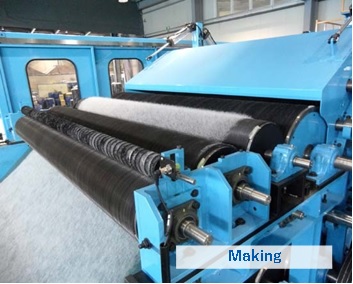
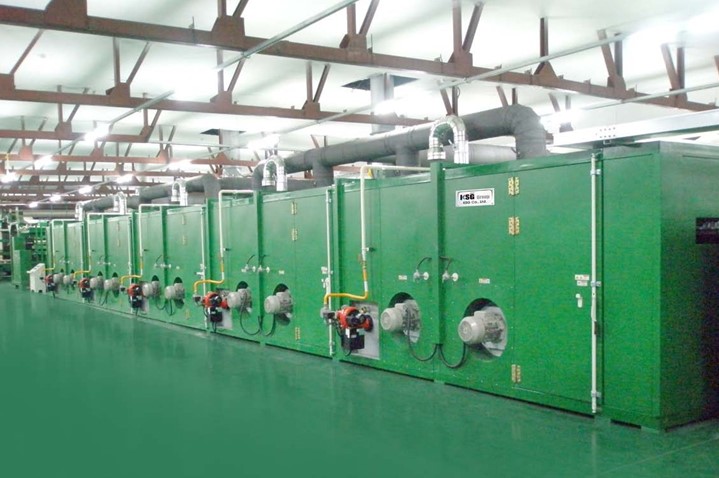
KSG builds complete dry-laid carded nonwoven lines, and for many of the products people first associate with airlaid, a carded line is what actually gets specified. The opening line and hopper feeder prepare and dose the staple fibre; the carding machine forms an even web; the HS cross lapper lays it to target weight; and a heating roll or bonding dryer line consolidates it before a side, cross or rotary cutter finishes the roll.
For hygiene and wipe substrates we set the feed, cylinder and doffer sections up for fine, low-denier blends so the light webs stay uniform across the full width, which is where cheaper lines drift. The same engineering team that draws the layout installs and commissions it on the customer's floor, so the line hits saleable product without a chain of subcontractors arguing over who owns which section.
In fairness to the buyer: KSG does not manufacture an air-forming head, and a true airlaid nonwoven machine with fluff-pulp handling is outside our scope. If your product genuinely needs a pulp-based absorbent core, you will want an air-forming specialist for that station. If your product is a carded staple-fibre fabric, or the carded layers that pair with an absorbent core, that is precisely what we design, build and install.
KSG does not build airlaid air-forming machinery, and we would rather tell you that than sell you the wrong line. What we do build is the complete dry-laid carded route, opening, carding, cross lapping, bonding and cutting, that produces many of the same absorbent and wipe fabrics from staple fibre. Send us the product you are targeting and your output, and we will tell you honestly whether a carded line fits and, if so, design and install it.
Related equipment
Ready to integrate the Airlaid?
Contact our sales engineers to discuss integration, custom configurations, and pricing for your facility.