
Spunlace Nonwoven Line: A Practical Guide to Hydroentangling Machines
What a hydroentangling line actually does, where it fits against needle punching, and the carded web that feeds both.
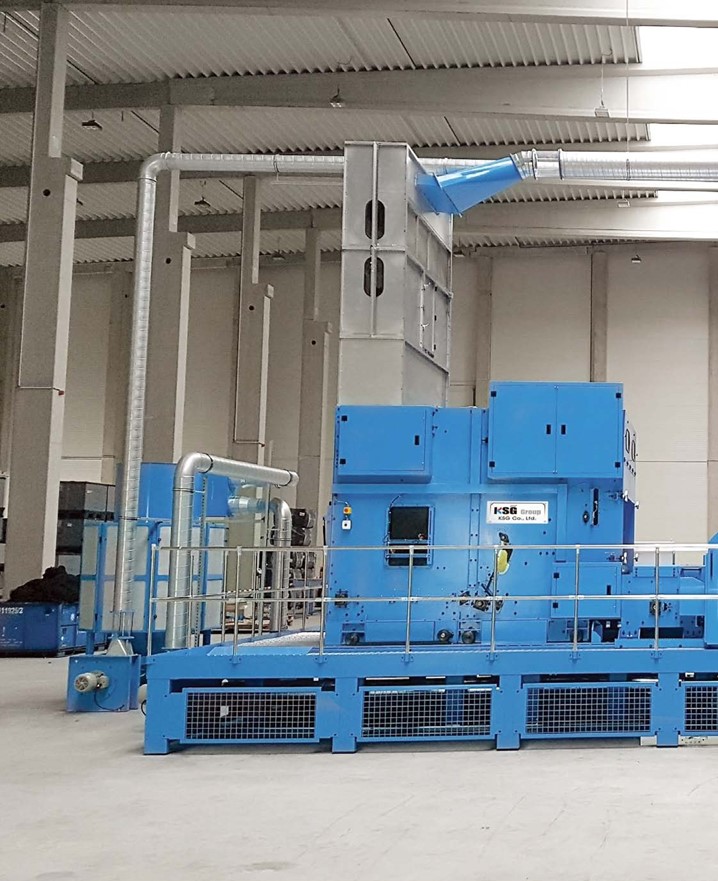
Buyers searching for a spunlace nonwoven line are usually after soft, strong, lint-free fabric for wipes or medical use. This guide explains how hydroentanglement works in plain terms, where it beats other bonding methods and where it does not, and how it relates to the dry-laid carding lines KSG builds. We will be straight about scope: KSG manufactures the carded web-forming front end that a spunlace line depends on, not the high-pressure water jet section itself. Knowing that split up front saves everyone time.
How hydroentanglement works
Spunlace, or hydroentangling, bonds a fibre web without needles, heat or glue. Instead, rows of fine water jets fire down through the moving web at high pressure, and the jets drag and knot the fibres around each other until the web holds together as a fabric. The manifolds sit above a perforated drum or moving screen, and the pressure typically steps up from a light pre-wetting pass to progressively harder injectors as the web consolidates.
The result is a fabric that is soft, drapeable and low in lint, which is exactly why it dominates the premium wipe and medical market. Web weights for wipes commonly sit in the 40 to 70 gsm range, with the line running fast because water does the bonding work continuously rather than in a slower mechanical stroke. Fibre choice matters too: viscose, polyester, cotton and blends all behave differently under the jets, and the injector pressures are tuned to suit.
The trade-off is water and energy. A hydroentangling machine needs a substantial closed-loop water system, filtration to keep the jets from clogging, and a drying section afterward to pull the moisture back out of the wet-laid or wet-bonded web. That water treatment and drying load is a real part of the running cost, and it is worth modelling honestly before a plant commits to spunlace over a drier process.
Where spunlace is used
The obvious home for a spunlace production line is wipes. Baby wipes, household and industrial wipes, and cosmetic pads all lean on the softness and strength that water jets give. Because the fabric can be made lint-free and can carry dispersible or flushable fibres, converters value it where a needle-punched or thermally bonded web would feel too coarse.
Medical and hygiene products are the other big pull. Surgical gowns, drapes, swabs and wound-contact layers want a clean, soft, particle-free fabric, and spunlace delivers that well. These end uses come with tight quality expectations, so uniformity of the incoming web is not negotiable, which brings the conversation straight back to the carding and lapping equipment that forms that web.
Spunlace vs needle punching
Spunlace and needle punching are cousins: both are mechanical bonding methods that entangle fibres rather than melting or gluing them. The difference is the tool. Needle punching drives barbed needles through the web to knot the fibres, giving a firmer, often heavier felt suited to geotextiles, automotive and filtration. Spunlace uses water and produces a softer, lighter, cleaner fabric aimed at wipes and medical goods.
Practically, that means they serve different products even though they share the same beginning. If your target is a durable felt in the 150 gsm-and-up bracket, a needle punching machine or a velour needle loom is the right tool. If your target is a soft 50 gsm wipe, hydroentangling wins. Neither is simply better; they are different answers to different jobs, and a serious buyer should scope the end product before scoping the bonding line.
The point most vendors gloss over is that the front end is identical. Both processes start with opened, carded and cross-lapped fibre, and the quality of that web sets the ceiling for both. A streaky or uneven web will show up as weak spots after the jets just as it does after the needles.
The shared front end KSG supplies
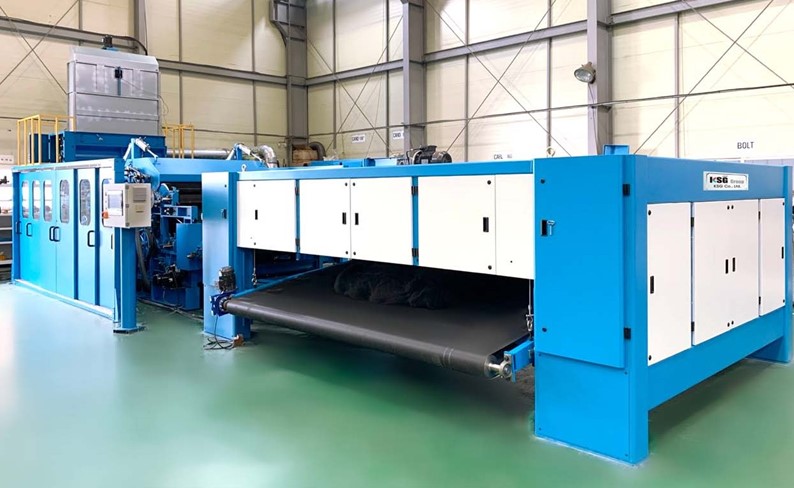
Whatever bonds the web, the fibre first has to be opened, blended, carded and laid down evenly, and that is the part KSG designs and builds. A hopper feeder and opening line prepare and dose the fibre; the carding machine opens and aligns it into a uniform web; and the HS cross lapper builds that web up to target weight and width while controlling fibre orientation. For a spunlace producer, this is the section that decides whether the finished fabric is uniform.
Because low-lint wipe and medical fabrics live or die on web evenness, we specify the feed, cylinder and doffer sections around fine, low-denier blends rather than a heavy generic setup. A card and lapper tuned for coarse geotextile fibre will not give a clean lightweight web, and no amount of water pressure downstream fixes that.
To be clear about scope, KSG does not manufacture the high-pressure water-jet manifolds, pumps or water-treatment plant that make a line a true hydroentangling machine. What we supply is the carded web-forming line that feeds it, and the dryers, cutters and controls around the process. If you are planning a spunlace project, we are glad to advise on that front end and how it should integrate with a jet section from a specialist supplier.
KSG does not build the water-jet section of a spunlace nonwoven line, and we will not pretend otherwise. What we do build is the dry-laid carding and cross-lapping front end that both spunlace and needle-punch fabrics depend on, along with the drying and cutting equipment around it. If your real need is a needle-punched felt, or a carded web to feed a hydroentangling line, tell us your product and output and we will design and install that equipment for you.
Related equipment
Ready to integrate the Spunlace?
Contact our sales engineers to discuss integration, custom configurations, and pricing for your facility.