Geogrid Nonwoven Line and Drainage Nonwoven Fabric Machine Plant
Composite reinforcement backings and high-flow drainage fabrics from one plant.
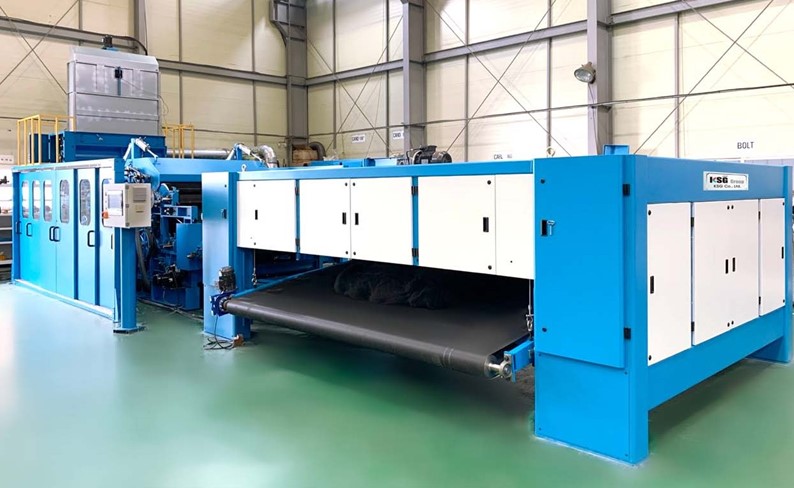
Geogrid composites and drainage fabrics sit at the demanding end of the civil sector. A geogrid nonwoven line has to make a dimensionally stable carrier that a grid or geomembrane can be laminated or stitched to, while a drainage nonwoven fabric machine has to deliver high in-plane and cross-plane flow that survives compression under fill. Both come off broadly the same equipment family, tuned differently. KSG can set up the whole plant.
Two products, one core train
For geogrid backings the priority is a flat, stable, evenly consolidated nonwoven that behaves predictably when a grid is bonded or laminated onto it. That means careful cross lapping for uniformity and a needling profile that consolidates without over-densifying. For drainage fabrics the goal is almost the opposite: an open, lofty, high-permeability structure that keeps its flow path when a load sits on it. Same carding and lapping backbone, different fiber blends, needling depth and finishing.
Because one KSG line can be set to run both families, producers who serve civil contractors get flexibility without a second plant. Changeover is mostly a recipe and needle-board matter plus web-weight adjustment on the cross lapper, not a mechanical rebuild. We set those recipes up during commissioning so operators are switching between known, repeatable states rather than guessing.
Planning the plant, not just the machines
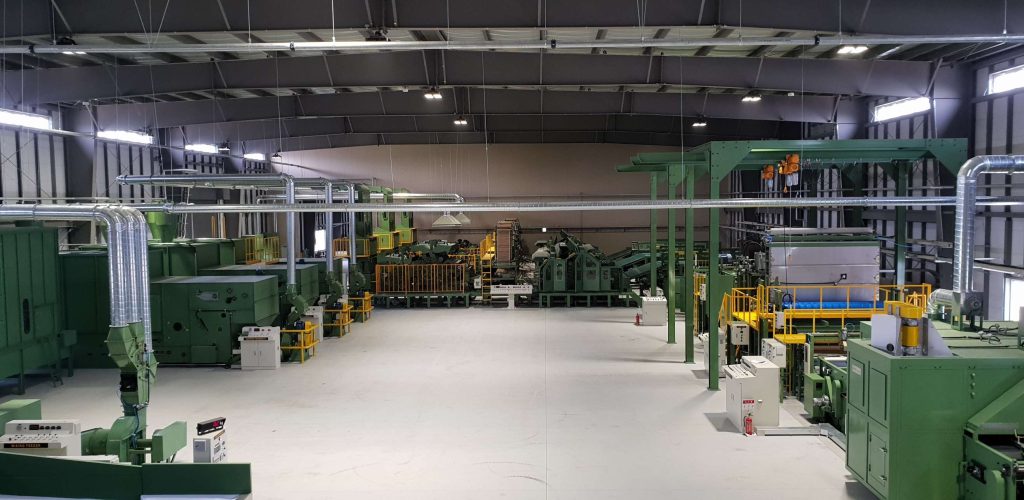
Plant setup for civil fabrics is as much about the building as the equipment. Heavy geotextiles mean big bale stores, dust and fiber-fly management around the opening line, wide roll handling at the winder, and floor loading that suits a long, heavy line. We provide the factory layout early so your civil and electrical contractors can plan foundations, extraction and power before machines arrive. It is far cheaper to move a line on a drawing than on the floor.
Where the fabric is resin-bonded or needs heat setting, a dryer or heated section joins the train after needling. We match the dryer capacity to the line's throughput so it is not the bottleneck. Getting utilities sized right at this stage, air, power and heat, is one of those unglamorous details that decides whether the plant hits its rated output in month one or month six.
Delivery, installation, and support
We build the equipment in Korea, ship it, and send our own engineers to install and commission it. On a plant of this size that usually means several weeks on site: mechanical assembly, alignment, electrical and control integration, then fiber trials until the drainage and geogrid grades both run to spec. Having installed lines across more than 40 countries, we plan around the practical stuff, customs, crane access, local power quality, so start-up does not stall on surprises.
After hand-over you deal with one supplier for spares, clothing, needles and technical support. For a producer selling into civil projects with long warranty and performance obligations, that single line of responsibility matters. If a fabric spec needs adjusting two years in, the people who designed the line are the ones you call.
Whether you need a dedicated drainage nonwoven fabric machine, a geogrid backing line, or a flexible plant that runs both, KSG Group can engineer, build and install it as a turnkey project. Share your target fabrics, widths and volumes and we will return a plant layout, equipment list and commissioning plan.
Related equipment
Related Technology Guides
Ready to integrate the Civil & Construction?
Contact our sales engineers to discuss integration, custom configurations, and pricing for your facility.