
Thermal Bonded Nonwoven Line: Heating Roll and Bonding Dryer Systems
Heating roll and through-air bonding dryer lines for low-melt fibre webs, engineered and installed by one team.
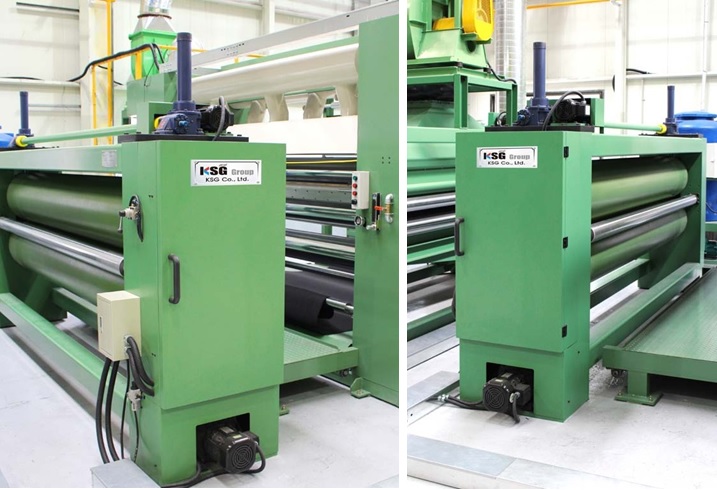
Thermal bonding is the quiet workhorse of the dry-laid world. Instead of stitching fibres together mechanically, you melt a fraction of the blend and let it set, so the web is held together by fused points rather than needle penetration. Done well it gives you a clean, dimensionally stable fabric with controllable loft and no needle marks. A thermal bonded nonwoven line lives or dies on temperature control, and that is exactly the part we spend the most time on when we lay one out for a customer.
How thermal bonding works on a dry-laid line
The principle is straightforward. You blend a bonding fibre, usually a low-melt bicomponent or a low-melt polyester or polypropylene staple, into the main fibre before carding. When the laid web passes through heat, the low-melt sheath softens and flows to the fibre crossover points while the higher-melt core stays intact and keeps the fabric's body. Cool it down and those melted points solidify into bonds. The share of low-melt fibre in the blend, often somewhere in a rough 10 to 30 percent band depending on the product, is one of the main levers on how stiff or soft the finished web comes out.
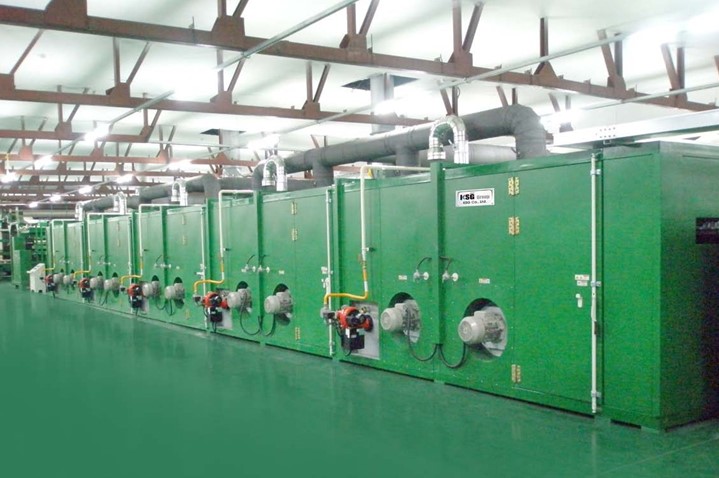
There are two common ways to deliver that heat, and they give different fabrics. A heating roll, or calender, presses the web between heated rolls to produce a flatter, denser, sometimes point-bonded fabric. A through-air bonding dryer pushes hot air through the web while it sits lofty on a conveyor, which sets the bonds without crushing the loft, so you keep the bulk and softness. Which route a customer needs comes straight out of the product: a firm interlining wants the roll, a lofty wadding or filter media wants the through-air dryer.
Temperature control and cooling
The whole process sits in a narrow temperature window. Too cool and the bonds are weak and the web delaminates; too hot and you overshoot the melt, glaze the surface, lose loft and can scorch the fabric. The gap between good and bad can be a matter of degrees and a matter of dwell time, so the heating section has to hold its setpoint steadily across the full working width, not just at the centre. We build the heating roll and the bonding dryer with zoned, well-controlled heat so the operator has a real setting to run to rather than a moving target.
Cooling is the step people forget, and it matters as much as the heat. The bonds only become the bonds once the melt has resolidified, so if you wind or cut the fabric while it is still warm you get roll blocking, distortion and inconsistent strength. We size a cooling device into the line after the bonding station so the web comes down to a stable temperature before it reaches the winder or the cutters. On a real line, matching heating capacity, line speed and cooling capacity to each other is what keeps the fabric consistent from the first roll of a run to the last.
Line speed and web weight set the rest of the sums. Heavier webs need more dwell to bond right through, so a heat bonding nonwoven line running a thick wadding runs slower than one making a light cover, and the dryer has to be sized for the slowest, heaviest product the plant intends to sell, not the easiest.
Where thermal bonding beats needling
Thermal bonding and needle punching are not rivals so much as tools for different jobs, and part of our design conversation is being honest about which one a customer actually needs. Needling gives strength and a mechanical, felt-like structure and handles heavy weights well, but it perforates the web and pulls fibres through, which is not what you want for a smooth, closed surface or a very light fabric. A thermal bonding machine leaves the surface intact, bonds very light webs that would be shredded by needles, and gives clean, uniform loft, which is why it dominates in wadding, interlinings, coverstock and many filter and hygiene-adjacent products.
There is also a fibre logic to it. Thermal bonding only works if the blend contains a fusible fibre, so it belongs to synthetic or synthetic-blend webs rather than pure natural-fibre felts, where needling or resin bonding still make more sense. When a customer's product suits fusible blends, thermal bonding usually wins on speed, surface quality and running cost, and we will say so. When it does not, we point them at needle punching or resin padding instead, because selling the wrong bonding route helps nobody.
The KSG heating roll and bonding dryer line
KSG supplies the thermal bonding section as an integrated part of the complete dry-laid line. Upstream, the fibre is opened and blended, a carding machine forms the web and an HS cross lapper builds it to weight and width; then the web passes into the heating roll or the bonding dryer line for consolidation, through a cooling device, and on to the side cutter, cross cutter and winder for finishing. Because we build and control every one of those stations, the bonding heat, the line speed and the cooling are matched to each other rather than negotiated between separate vendors.
Over more than 30 years and installations in over 40 countries we have learned that the bonding section is where commissioning problems tend to surface, so we install and start it up with our own engineers on site. The customer gets one partner from the first line drawing through to the first rolls that hit target strength and hand. If the fabric is not bonding right at start-up, it is our line and our job to bring it into spec.
If you are planning a thermal bonded nonwoven line or adding a bonding stage to an existing dry-laid plant, KSG can design, build and install the complete system, from heating roll or through-air bonding dryer to the cooling and finishing sections. Send us your product mix, target weights and output, and we will propose a line layout with a firm delivery and commissioning schedule.
Related industry guides
Ready to integrate the Thermal Bonding?
Contact our sales engineers to discuss integration, custom configurations, and pricing for your facility.