
Rotary Cutter (KS-RC700~800)
Scissor-action cutting for textile-waste preparation.
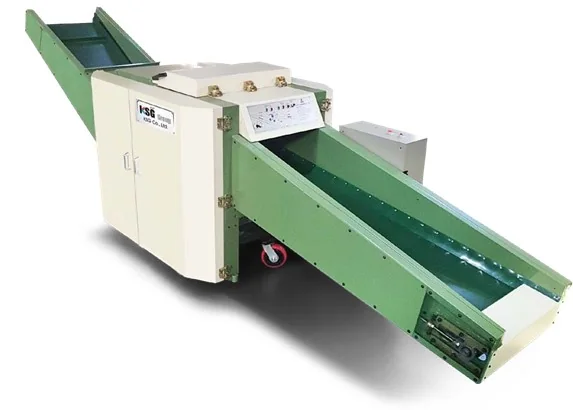
The rotary cutter is described for cloth scrap, old garments, and yarn textiles. In the recycled-felt drawing, two rotary cutting stages appear before the hopper feeder and opening units. This illustrates one layout, not a requirement for every recycling project.
Revolving blades work against a fixed blade in a scissor action. The catalogue describes adjustable cutting length, a covered revolving section, checking-door stop controls, and an optional metallic sensor.
Confirm the current guarding arrangement, sensor option, blade access, and cut-length setting for the offered machine. Test representative material rather than assuming that a catalogue production quantity applies to your mix of waste.
For an RFQ, state the incoming scrap form, composition, attachments, required cut size, and downstream opener. Include the feed and discharge connections in the machine scope.
The recycling brochure lists an adjustable cutting length of 25–150 mm for the two rotary-cutter widths shown. Use this as a configuration reference and agree the required cut on your own scrap with the downstream opener; it is not a recovered-fiber-length guarantee.
How this stage contributes to the line
Useful recovery begins with the right cutting and opening duty. KSG's range separates textile-scrap cutting, progressive fiber opening and edge-trim recovery. The recycled-felt layout connects these operations to cleaning, storage, forming and drying, helping buyers discuss a complete reuse route.
Explore KSG's integrated engineering approach Textile Waste to Recycled FeltInformation that defines the right configuration
Equipment selection and pricing depend on the product, process, output, site, and supply scope. Prepare these points before requesting a technical proposal.
Product and application
End use, sample product, quality targets, roll or pack format, and required product range.
Raw materials
Fiber or polymer, blend, denier, staple length, additives, and material condition.
Output and dimensions
Target throughput, GSM range, finished and process width, tolerances, and changeovers.
Facility and utilities
Layout, clear height, access, power, heat, air, water, ventilation, and local standards.
Project and support scope
Automation, controls, installation, commissioning, training, acceptance, and spare parts.
What to verify before choosing a textile cutter
Both recycling catalogues describe scissor-action cutting of cloth scrap, old garments, and yarn, with adjustable cutting length. Output on your waste needs a material-specific review.
| Source-described feature | Quotation question |
|---|---|
| Revolving blades against a fixed blade | Which blade arrangement is offered for the material? |
| Adjustable cutting length | What setting and output-size criteria will be tested? |
| Covered revolving section and checking-door stop controls | What current guarding and safety documentation are included? |
| Optional metallic sensor | Is the sensor included, and what does it detect? |
Sources: FIBER_RECYCLING_CARDAROG_1790837152410.pdf, p. 2 (publication date not stated); KSG_카다로그_2023.12.29일_1790837133001.pdf, p. 58 (filename date December 29, 2023; publication date not established). Catalogue production quantities are not a guarantee for an unspecified waste mix.
Key Features
Textile-waste preparation
Described for cloth scrap, old garments, and yarn textiles.
Scissor-action cutting
Revolving blades intersect a fixed blade to cut the incoming material.
Adjustable cutting length
The catalogue describes length adjustment; confirm the setting range for the offered configuration.
Covered cutting section
The source describes a cover and checking-door stop controls. Confirm current safety details in the proposal.
Metallic-sensor option
A sensor is described as optional, not standard equipment or a complete contamination-removal system.
Applications
Interested in the Rotary Cutter (KS-RC700~800)?
Contact our sales engineers to discuss integration, custom configurations, and pricing for your facility.