
3-Mountain Waste Opener
Successive opening units for cotton and chemical-fiber waste.
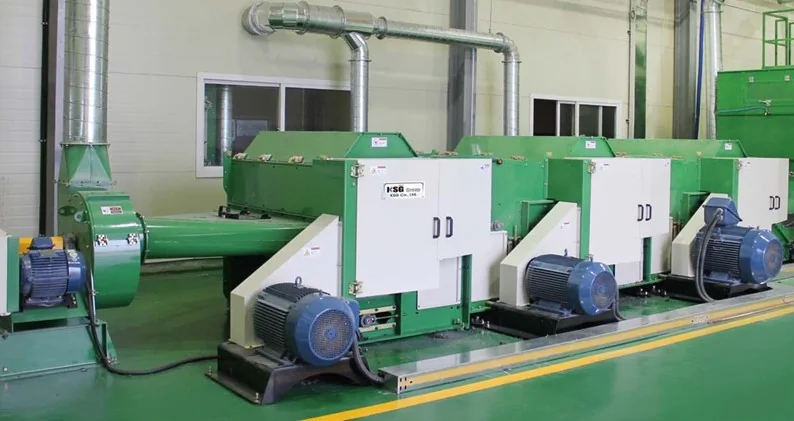
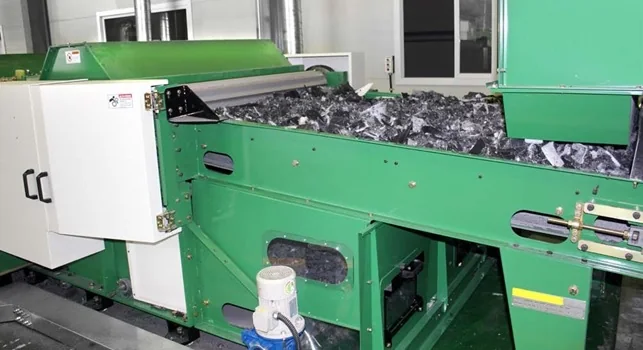
The 3-Mountain Waste Opener is described for cotton and chemical fibers such as acrylic and polyester. Successive beating and opening units prepare the recovered material for reuse; the finished product depends on the waste and the downstream process.
The materials describe configurations with one, two, three, or more working units. Choose the stage arrangement through material review and trials, rather than assuming that adding units guarantees a particular fiber length or output.
Model identifiers and capacity statements differ between the supplied documents and earlier website copy. A consolidated specification table is therefore not published here. Ask KSG to confirm the current model, working width, drives, and output on your material in the quotation.
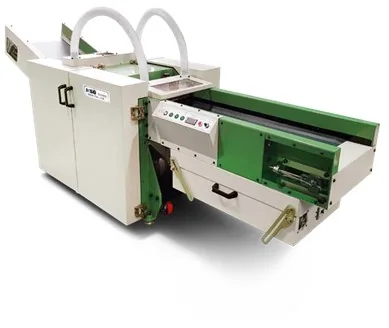
Related catalogue equipment includes a trimming waste opener for edge-cut nonwoven fabric and a waste opener for garments, yarn, or nonwoven waste. These are different recovery duties; the trim-opener model and specification also need confirmation before selection.
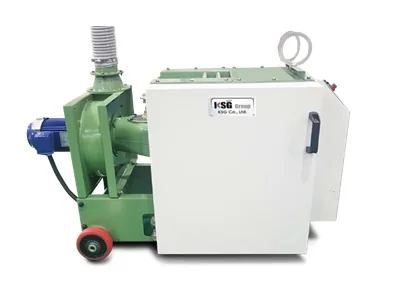
For a smaller recovery duty, the separate Waste Opener-500 is described for garments, yarn and nonwoven waste. Both supplied catalogues list 500 mm working width and 30–75 kg/h. These reference values belong to that machine, not the multi-stage opener; confirm output on the actual material.
How this stage contributes to the line
Useful recovery begins with the right cutting and opening duty. KSG's range separates textile-scrap cutting, progressive fiber opening and edge-trim recovery. The recycled-felt layout connects these operations to cleaning, storage, forming and drying, helping buyers discuss a complete reuse route.
Explore KSG's integrated engineering approach Textile Waste to Recycled FeltInformation that defines the right configuration
Equipment selection and pricing depend on the product, process, output, site, and supply scope. Prepare these points before requesting a technical proposal.
Product and application
End use, sample product, quality targets, roll or pack format, and required product range.
Raw materials
Fiber or polymer, blend, denier, staple length, additives, and material condition.
Output and dimensions
Target throughput, GSM range, finished and process width, tolerances, and changeovers.
Facility and utilities
Layout, clear height, access, power, heat, air, water, ventilation, and local standards.
Project and support scope
Automation, controls, installation, commissioning, training, acceptance, and spare parts.
Specify the opening duty before the model
The sources identify cotton, acrylic, and polyester and describe one, two, three, or more working units. Model and capacity inconsistencies prevent a reliable consolidated specification.
| Recovery duty | What to confirm |
|---|---|
| Main textile-waste opening | Waste sample, stage arrangement, current model, width, and trial output |
| Edge-trim recovery | Trim construction, recovered-fiber requirements, and approved trim-opener specification |
| Garment, yarn, or nonwoven waste | Whether the separately described waste opener suits the feedstock |
Why is there no numeric specification table?
The supplied description and table give different daily capacities, while model identifiers also differ from earlier website copy. Ask for a current approved specification and output conditions for the exact offered machine.
Sources: FIBER_RECYCLING_CARDAROG_1790837152410.pdf, pp. 3–4 (publication date not stated); KSG_카다로그_2023.12.29일_1790837133001.pdf, pp. 56 and 59–60 (filename date December 29, 2023; publication date not established). Conflicting model and trim-opener table details are withheld pending confirmation.
Gallery
Key Features
Named fiber families
Cotton, acrylic, and polyester are identified in the source description; review other blends separately.
Modular opening stages
The catalogue describes one, two, three, or more working units.
Progressive material preparation
Successive units beat and open the waste before the selected downstream process.
Separate trim-recovery duty
An edge-trim opener is described separately from the main textile-waste opener.
Configuration confirmation
Obtain an approved model-specific specification and material-trial basis before ordering.
Applications
More in Fiber Recycling Machinery Line
Interested in the 3-Mountain Waste Opener?
Contact our sales engineers to discuss integration, custom configurations, and pricing for your facility.